The Most Precise Methods for Dental Implant Placement
The future is here: Nobel X-Guide. The Most Precise Methods for Dental Implant Placement
Why is the “Perfect” Position Critical?
Before discussing the technologies, we must understand why simply screwing an implant into the bone is not enough. The success of dental implantation depends not only on whether the implant fuses with the bone (osseointegration) but also on where and at what angle it is positioned.
1. Anatomical Safety
Our jawbone is not a homogeneous block. It is full of sensitive structures: the nerve canal runs through the lower jaw (mandible), and damaging it can cause permanent numbness, while the proximity of the sinus cavity presents a challenge in the upper jaw (maxilla). Millimeter precision is no exaggeration here: maintaining a safe distance is a prerequisite for complication-free healing.
2. Long-term Load Bearing
Think of an implant as the foundation of a house. If the foundation is tilted, the structure built upon it (the crown or bridge) will be statically unstable. If the implant is not placed according to the direction of chewing forces, the bone can become overloaded, leading to bone resorption and implant loss over time.
3. Achievable Aesthetics
In modern dentistry, the goal is not just to provide chewing function but to ensure the result is indistinguishable from natural teeth. We call this “prosthetically driven implantology.” This means the implant must be placed where the future tooth needs to be, not necessarily where there is the most bone. This approach requires careful planning and surgical precision.
The Evolution of Implant Placement: From Freehand to Space Technology
How does the dental implant get into place? As technology has advanced, three main categories have emerged. Let’s look at their pros and cons!
1. The Traditional Method: “Freehand” Placement
This is the oldest and still most commonly used procedure. Here, the surgeon plans the surgery mentally based on preliminary X-rays (panoramic X-ray or CT) and relies on their own eyes and experience to drill the site for the implant during the operation.
- How it works: The doctor cuts the gum to see the bone, then directs the drill based on visual estimation.
- Advantages: No need for expensive preparation or special tools, making it potentially cheaper in many cases. It can work well for routine cases in the hands of an experienced surgeon.
- Disadvantages and Risks:
- Human Factor: Even the most professional surgeon’s hand can tremble, or visual estimation can be off by 1-2 millimeters, which is a huge distance in implantology.
- Larger Incision: To see what they are doing, the doctor usually has to make a larger incision (flap elevation), resulting in swelling and more painful healing.
- Flying Blind: Although the CT scan is available, during surgery, the doctor cannot see inside the bone or view the drill tip’s distance from the nerve in real-time.
2. Static Navigation: Surgical Guides
The first major step in digital dentistry was the appearance of 3D-printed guides. This is a much more precise procedure than the freehand method.
- How it works: The patient’s CT scan and intraoral scan are merged in software. The implant position is planned on the computer, and a hard plastic splint (guide) with built-in metal sleeves is printed. During surgery, this is fixed to the patient’s teeth or gums, and the drill is guided through these sleeves. The sleeve prevents the drill from deviating from the planned direction.
- Advantages: Eliminates the uncertainty of the freehand method. Allows for more accurate positioning.
- Limitations:
- Static System: If anything unexpected happens during surgery (e.g., bone density is different than expected), the plan cannot be changed since the guide is already printed.
- Cooling Difficulties: Due to the closed plastic guide, the physiological saline (cooling fluid) has a harder time reaching the drill tip, carrying a risk of bone overheating.
- Difficult Access: For posterior teeth, where patients have trouble opening their mouths wide, the thick guide and long drills often make physical access impossible.
- Time-consuming: Manufacturing the guide can take days or weeks.
3. The Cutting Edge: Dynamic Navigation – The Nobel X-Guide
This brings us to the most modern technology currently available. The Nobel X-Guide system is often referred to as the “GPS” of surgery. This method combines the flexibility of freehand surgery with the surgical precision of digital planning, eliminating the drawbacks of static guides.
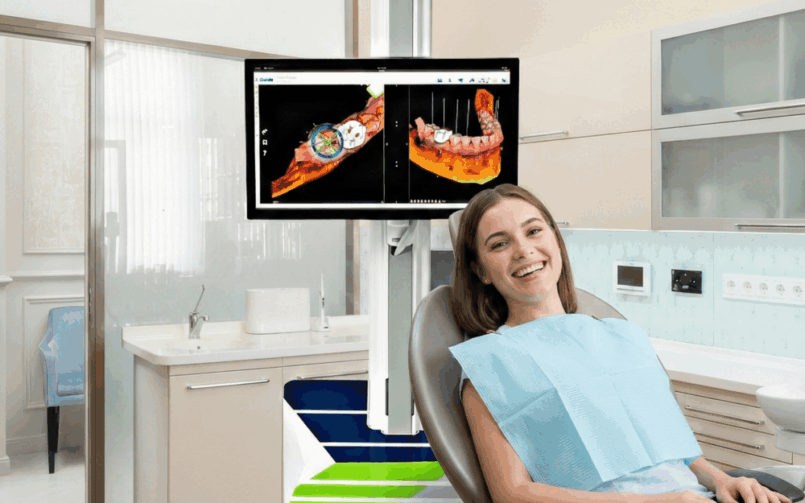
- How it works: Similar to technology used in neurosurgery, the X-Guide is a live, real-time navigation system. During surgery, special markers (trackers) are placed in the patient’s mouth and on the surgical instruments, which are monitored by a high-resolution 3D camera. The surgeon does not look directly at the patient’s mouth but at a monitor, where they see the movement, depth, and angle of their drill on the CT scan in real-time—as if working within transparent bone.
Why Does the Nobel X-Guide Stand Out?
Dynamic navigation is not just another “gadget”; it is a paradigm shift in implantology. Let’s look point by point at the benefits X-Guide offers patients compared to guides and the freehand method.
1. Real-Time, Millimeter Precision
The system provides continuous feedback. If the surgeon’s hand deviates even half a degree from the planned axis, the crosshair color on the screen changes, and an audio signal warns them. This level of control is unattainable with human eyes and hands alone. Research shows that implants placed with dynamic navigation are significantly more accurate than those placed via the freehand method.
2. Total Transparency Instead of “Flying Blind”
With X-Guide, the doctor sees the bone structure at every moment of drilling. They can see how close they are to the nerve or sinus, even if these are covered by gums to the naked eye. This drastically reduces surgical risk and the chance of injury.
3. Minimally Invasive Procedure with X-Guide (Flapless Surgery)
Because the system “sees through” the gums, in many cases, there is no need to cut and flap the gums. The doctor performs the procedure through a tiny, circular hole (known as the punch technique).
- What does this mean for the patient? Less bleeding, minimal swelling, almost no pain after surgery, and healing time is reduced to a fraction. No suture removal is needed, and return to daily life is almost immediate.
4. No Waiting Time (Immediate Care)
Unlike static guides, which must be manufactured in a lab (taking days), X-Guide is completely digital. After the CT scan and computer planning, the surgery can be performed immediately. This is particularly important for those arriving from abroad or who simply do not want to wait weeks for their new teeth.
5. Intra-operative Flexibility
Static guides are rigid—if the guide doesn’t fit perfectly, the whole surgery must be postponed or continued freehand. With X-Guide, if the surgeon decides during surgery that the implant position needs modification due to bone quality, this can be done with a few clicks in the software, and the navigation adapts to the new plan instantly.
6. Better Cooling and Access
Since there is no bulky plastic guide in the mouth, drill cooling is perfect (water flows freely), so the bone does not overheat, which is key to rapid osseointegration. Additionally, the doctor can access posterior teeth more easily as the guide takes up no space.
Summary: The Future of Dentistry is Accessible
Technological development in dental implantation hasn’t stopped. While the freehand technique can still be effective in the right hands, and guides serve a good purpose, Nobel X-Guide dynamic navigation elevates patient safety and surgical precision to an entirely new level.
The biggest winners of this system are the patients themselves:
- The security of knowing the implant is guaranteed to be in the best place.
- Comfort, as the procedure is often done without cuts or stitches.
- Speed, as there is no need for guide manufacturing.
- Durability, guaranteed by perfect positioning.
If you are facing dental implant surgery, it is worth choosing a clinic where this cutting-edge technology is available. The X-Guide is not just a tool in the doctor’s hand, but a guarantee for you that your smile will rest on the most secure foundations possible.
Do you want to know if X-Guide navigated implantation is suitable for you? Request a consultation appointment today and experience the benefits of modern dentistry!

Dr. András Győrfi is a leading expert in aesthetic and restorative dentistry and the founder of the Smile Designers clinic. With a career spanning back to 2006, he is a graduate of the University of Pécs and specialized at the University of Szeged. Since 2014, he has been the driving force behind Smile Designers, focusing on his passion: smile makeovers, dental veneers, and implantology. Dr. Győrfi believes in a collaborative approach, working alongside a premier team of specialists to deliver life-changing dental transformations with precision and care.
You must be logged in to post a comment.